
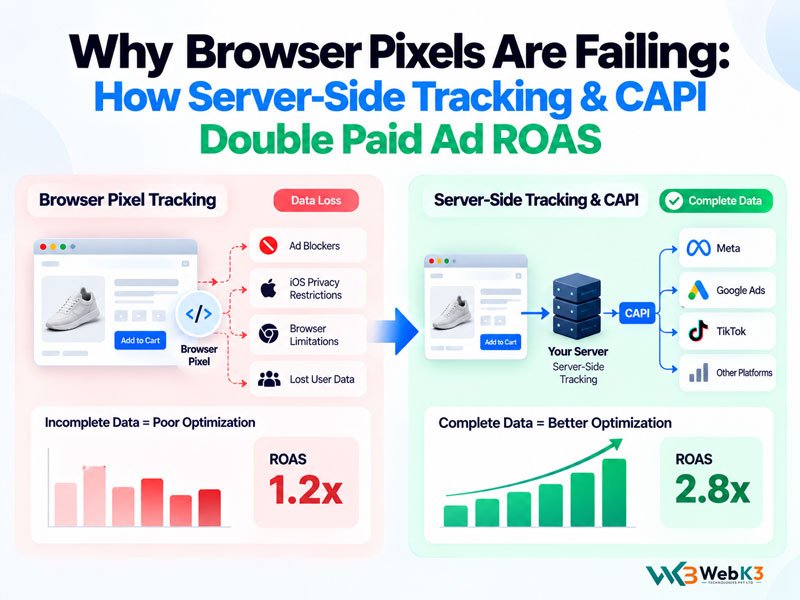
If your marketing dashboard shows steady ad clicks but your sales team complains that incoming leads are stagnant or low quality, you are likely suffering from client-side data loss.
Over the last several years, the technical plumbing of digital advertising has fundamentally shifted:
- Apple’s iOS App Tracking Transparency (ATT) restricted third-party cookie tracking.
- Popular desktop and mobile browsers (Brave, Safari, Firefox) aggressively block traditional client-side JavaScript pixels.
- Over 42% of global internet users browse with ad-blockers enabled.
When your ad tracking relies entirely on a standard client-side browser pixel (Meta Pixel or Google Ads tag pasted into your header), up to 30% to 40% of conversion events never reach the advertising algorithms.
Without accurate event feedback, Google and Meta’s machine-learning bidding models operate blind. They bid on cheap, low-intent users who happen to trigger page loads, while your Cost Per Lead (CPL) steadily climbs.
Here is how modern growth teams fix this through Server-Side Tracking, Meta Conversions API (CAPI), and Technical Conversion Engineering.
The Technical Problem: Client-Side vs. Server-Side Tracking
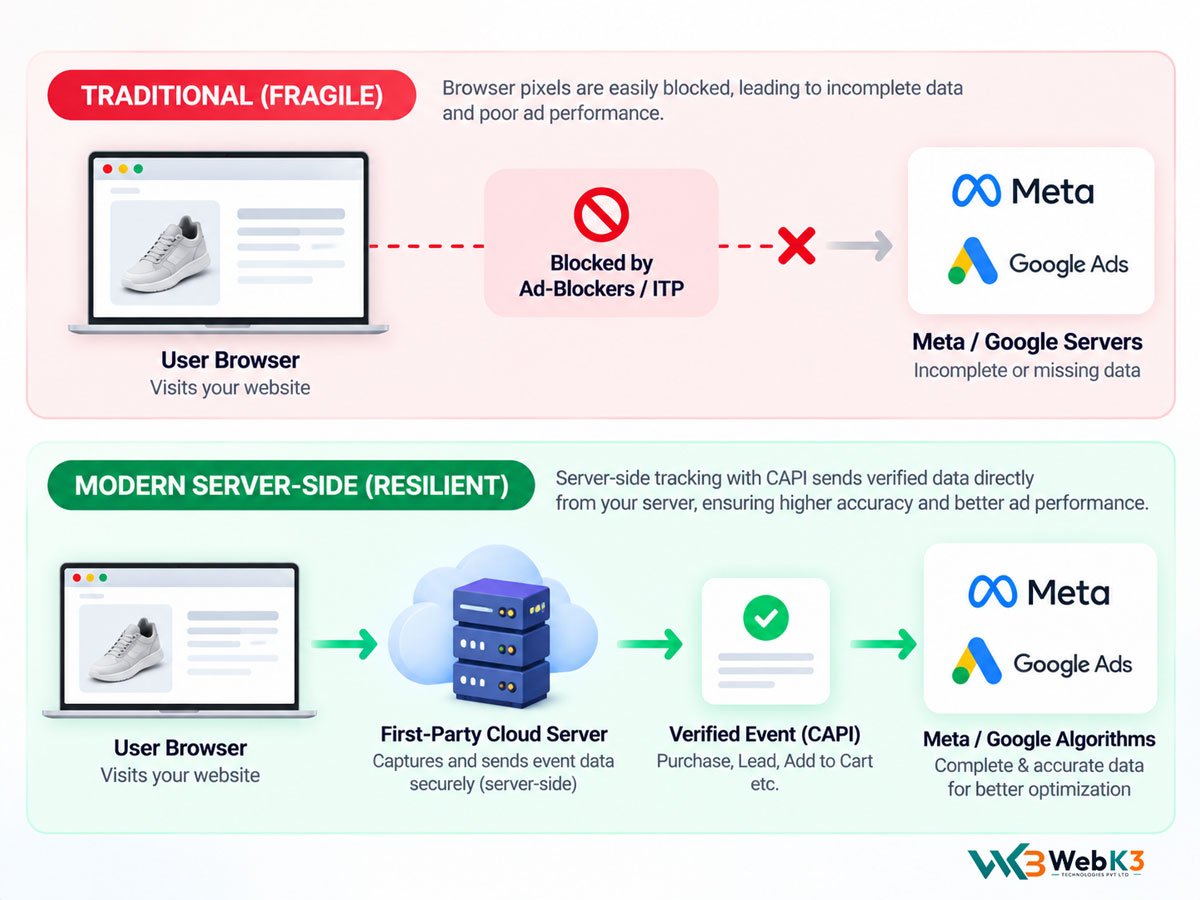
To understand why campaigns stall, look at how data moves from a user's browser to Meta or Google:
| Feature | Traditional Client-Side Pixel | Server-Side Tracking (sGTM + CAPI) |
| Execution Point | User's local browser | Your secure cloud server / proxy |
| Ad-Blocker Vulnerability | Blocked easily by extensions & DNS filters | Immune to client-side ad-blockers |
| Cookie Lifespan | Cut short (Safari ITP caps at 1–7 days) | Set as first-party HTTP-only (extended durability) |
| Data Accuracy | Estimates 60–75% of actual conversions | Captures 95–99% of verified conversions |
| Impact on Page Speed | Multiple third-party tracking scripts slow rendering | Single clean data-layer stream to server |
3 Technical Levers That Drive Sustainable Ad ROAS
1. Implementing Meta Conversions API (CAPI) with Redundant Deduplication
The Conversions API (CAPI) connects your website directly from your server to Meta's endpoints.
- Instead of waiting for a browser to execute an ad script, the conversion event (Lead, Purchase, Add to Cart) is sent directly from your backend database to Meta over a secure HTTPS connection.
- Deduplication: By sending matching
event_idand hashed parameters (external_id, hashed email, phone number) across both the browser pixel and the server, Meta deduplicates duplicate hits and achieves Event Quality Match scores of 8.5/10 or higher.
This immediate signal feedback allows Meta's Delivery Algorithm to find more users identical to your actual paying clients, dramatically lowering CPA.
2. Sub-Second Landing Page Architecture
Driving paid traffic to a sluggish, bloated homepage is one of the fastest ways to burn your marketing budget.
- Google’s data indicates that as page load time goes from 1 second to 3 seconds, the probability of a bounce increases by 32%. At 5 seconds, it increases by 90%.
- When visitors bounce before the page even finishes rendering, your tracking pixel doesn't fire, you pay for the click, and you gather zero conversion data.
High-converting campaigns demand dedicated, distraction-free landing pages built on clean code (semantic HTML5, zero render-blocking CSS, pre-loaded hero images) that achieve 90+ Core Web Vitals performance.
(Tip: You can evaluate your current landing page's speed and conversion friction instantly using our free Page Quality Checker diagnostic tool).
3. Closed-Loop CRM Offline Conversion Sync
True performance marketing does not stop at the lead form. Not all leads are created equal. If an ad campaign brings in 100 leads, but 20 are junk and 5 turn into high-value clients, how does Meta know which audience segment to expand?
Through Offline Conversion Tracking, your CRM (such as Zoho or HubSpot) sends a webhook back to Meta and Google when a deal moves from "Lead Ingested" to "Contract Signed." This closes the loop: the ad algorithm trains itself to hunt for actual closed revenue rather than cheap, tire-kicker clicks.
The WebK3 Advantage: Engineering Meets Performance
Most creative agencies run ad campaigns without knowing how to edit an .htaccess file, set up server-side DNS containers, or configure GTM data layers. On the other hand, traditional software teams don't understand ad creative fatigue or hook rates.
WebK3 was built to unify these two disciplines under one roof:
- We build the tech: Server-side tracking, custom landing pages, and automated webhook routing.
- We drive the growth: High-intent Google Search, Performance Max, and Meta lead funnels managed for maximum Return on Ad Spend.
Ready to Turn Paid Traffic into Predictable Revenue?
Stop guessing whether your pixels are firing accurately or why your ad spend is failing to produce sales. Let our technical marketing team audit your infrastructure and scale your inbound pipeline.
Discover our Lead Generation & Paid Ads Services or Request a Performance Marketing Audit with our specialists today.