

A common reason early-stage Software-as-a-Service (SaaS) products fail is not a lack of market interest, but premature over-engineering or fragile codebases that collapse upon user acquisition.
Building a Minimum Viable Product (MVP) requires balancing speed-to-market with a reliable technical foundation. An effective MVP should be lightweight enough to deploy within 8 to 12 weeks, yet architected with clean data isolation and scalable APIs so it does not require a complete rewrite after securing early traction.
This technical guide outlines the 4-stage engineering lifecycle, multi-tenant database considerations, and realistic cost benchmarks for building a modern SaaS product.
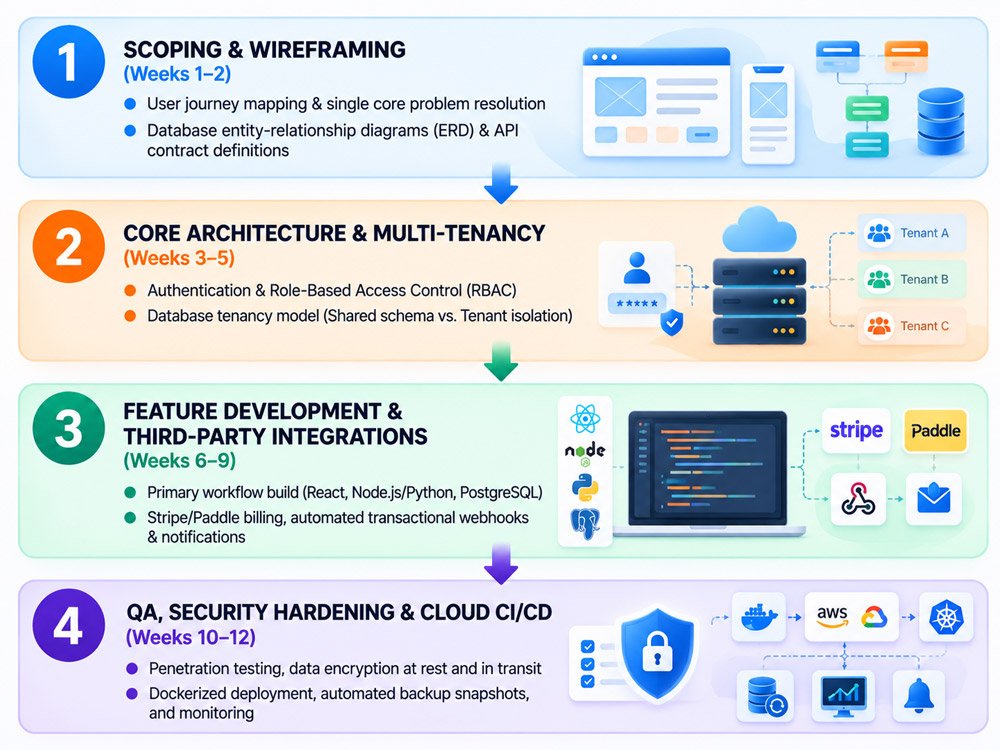
The 4-Stage SaaS MVP Engineering Framework
Multi-Tenancy: Choosing the Right Data Isolation Model
Selecting a tenancy architecture early dictates cloud infrastructure costs and data security compliance:
- Shared Database, Shared Schema (Row-Level Security):
- How It Works: All tenants share the same database tables, with a unique
tenant_idcolumn distinguishing records. - Best For: B2B and B2C SaaS platforms prioritizing cost efficiency and ease of centralized database migrations.
- Shared Database, Separate Schemas:
- How It Works: Tenants share one physical database cluster, but each customer has an isolated PostgreSQL schema.
- Best For: Mid-market B2B applications where business customers require distinct data boundaries without the cost of dedicated servers.
- Database-per-Tenant:
- How It Works: Each client operates on a dedicated database instance.
- Best For: Enterprise applications in healthcare (HIPAA) or finance (SOC 2) with strict legal data-isolation mandates.
Modern SaaS MVP Tech Stack Options
- Front-End Layer: React.js, Next.js, or Vue.js for responsive single-page applications (SPAs) with server-side rendering for marketing routes.
- Back-End API Services: Node.js (TypeScript) or Python (FastAPI/Django) delivering lightweight RESTful or GraphQL endpoints.
- Database & Cache: PostgreSQL for relational data integrity coupled with Redis for session management and background task queues.
- Cloud & DevOps: AWS, Google Cloud, or modern PaaS setups utilizing Docker containers, automated GitHub Actions CI/CD, and Cloudflare CDN caching.
How Much Does Building a SaaS MVP Actually Cost?
Costs vary based on business logic, third-party integrations, and regulatory needs:
| Project Scope | Typical Timeline | Estimated Cost Range | Deliverables |
| Lightweight Prototype / Internal Tool | 4–6 Weeks | $4,000 – $7,000 | Core CRUD functionality, basic auth, no automated billing |
| Standard Commercial B2B SaaS MVP | 8–12 Weeks | $8,000 – $18,000 | Multi-tenant auth, role management, Stripe billing, API webhooks, responsive UI |
| Complex Enterprise Platform | 14–20+ Weeks | $20,000 – $40,000+ | High-volume data processing, custom AI/ML pipelines, enterprise compliance |
Turn Your SaaS Concept into an Operational Product
Developing a SaaS product requires disciplined scoping, modular engineering, and reliable cloud execution.
Consult with WebK3 Technologies to review your product roadmap, evaluate technical specifications, and receive a milestone-driven MVP quote.