

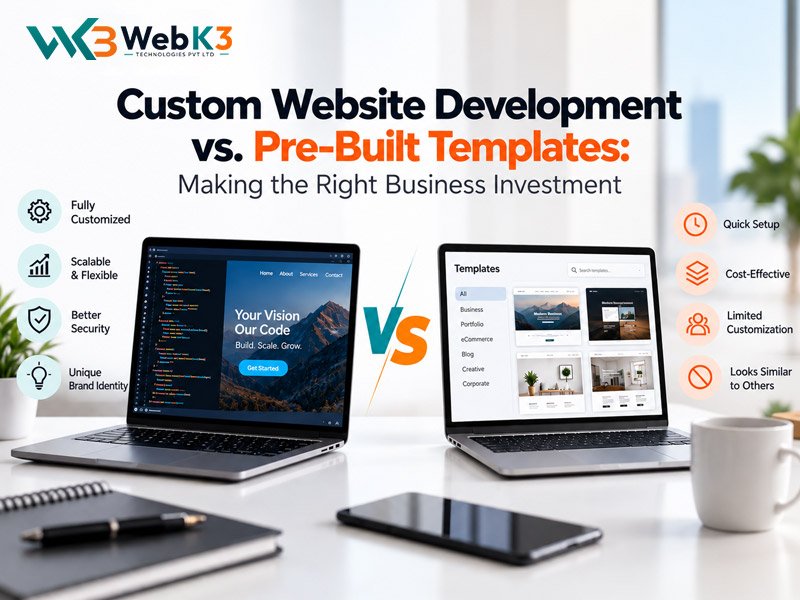
For business leaders planning a digital presence, the first decision often comes down to choosing between a pre-built CMS template (such as an off-the-shelf WordPress, Wix, or Shopify theme) and investing in custom website development.
At first glance, commercial templates appear economical: they cost between $50 and $150 and promise an operational site within days. However, as business requirements evolve—requiring custom CRM connections, unique customer portals, rapid load speeds, and strict security compliance—templates often introduce technical friction that can hinder growth.
This guide provides an objective evaluation of custom engineering versus pre-built templates, examining total cost of ownership, conversion impact, and long-term scalability.
Technical Comparison: Custom Engineering vs. Pre-Built Themes
| Evaluation Parameter | Pre-Built Commercial Template | Custom Web Development |
| Codebase Architecture | Generic, multi-purpose code loaded with unused CSS/JS | Clean, lightweight, bespoke code written strictly for your features |
| Page Speed & Core Web Vitals | Often fails Google LCP (<2.5s) due to heavy plugins and scripts | Optimized for Google Core Web Vitals and sub-second load times |
| Security & Vulnerabilities | Publicly known codebase; frequent targets for plugin exploits | Hardened surface area; custom database schemas and security headers |
| Third-Party Integrations | Dependent on third-party plugins that can break on update | Native API connections (REST/GraphQL) directly into your business tools |
| Scalability & Adaptability | Constrained by original theme styling and database layout | Fully modular; adapts to custom workflows, web apps, and portals |
The Hidden Costs of Pre-Built Templates
While templates offer low initial setup costs, growing companies often face unforeseen technical overhead:
- The Plugin Accumulation Problem: Pre-built templates require secondary plugins for basic business tasks (lead forms, custom post types, SEO tags, caching, security). Each added plugin introduces code conflicts, slows server response times (TTFB), and requires continuous patching.
- Design and Functional Bottlenecks: Modifying a pre-built layout often requires override stylesheets or child-theme workarounds that break when the core theme developer updates the source code.
- Core Web Vitals and SEO Penalties: Google prioritizes user experience through metrics such as Largest Contentful Paint (LCP), Interaction to Next Paint (INP), and Cumulative Layout Shift (CLS). Bloated template assets frequently fail these thresholds, suppressing organic visibility.
When Does a Template Make Sense vs. Custom Development?
Choose a Pre-Built Template If:
- You are validating an early proof-of-concept with minimal capital.
- Your website requires only static informational pages with no custom databases, client logins, or bespoke calculation tools.
- Page speed and high-intent organic search rankings are not primary customer acquisition channels.
Invest in Custom Web Development If:
- Your website serves as your primary sales engine, requiring high conversion rates and fast mobile performance.
- You require direct integrations with internal CRMs, ERPs, payment gateways, or custom APIs.
- You operate in regulated industries (healthcare, finance, enterprise SaaS) requiring stringent data privacy and compliance.
- Your brand identity requires a bespoke UI/UX experience that differentiates you from competitors using generic theme layouts.
Real-World Cost and Timeline Expectations
- Pre-Built Template Deployment: Typically ranges from $500 to $2,500 and takes 1 to 3 weeks. Long-term costs include ongoing plugin renewals, developer troubleshooting, and potential full rebuilds once the business outgrows the template.
- Custom Web Engineering: Typically ranges from $3,000 to $15,000+ depending on architectural complexity, database design, and interactive features. Development timelines average 4 to 8 weeks, with predictable maintenance, cleaner codebases, and lower long-term technical debt.
Next Steps for Your Web Project
If your current website struggles with slow load times, rigid styling, or fragile plugin integrations, a custom architecture can provide the performance and flexibility needed to scale.
Contact WebK3 Technologies to schedule a technical architecture review and receive a transparent project scoping consultation.