

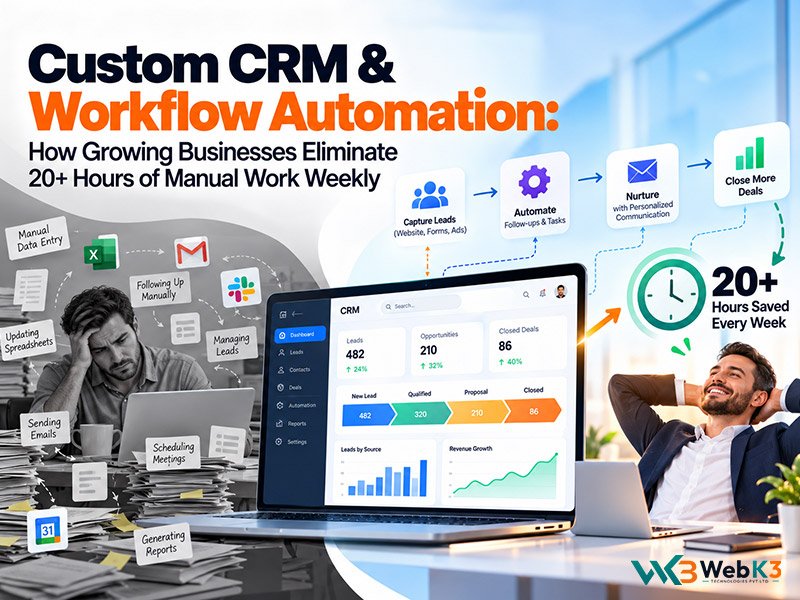
As companies grow, operational complexity often outpaces software capabilities. Teams find themselves manually copying data between web forms, email threads, customer databases, spreadsheets, and accounting software.
This manual data entry introduces three major operational risks:
- Slow Speed-to-Lead: Inbound inquiries wait hours for manual qualification and routing, drastically reducing close rates.
- Data Discrepancies: Duplicate records, typos, and mismatched statuses across sales and accounting platforms.
- Costly Administrative Drag: High-value managers spend up to 25% of their working hours maintaining records rather than driving revenue.
Custom CRM workflows and API automation connect these isolated systems into unified pipelines.
5 High-Impact Business Workflows You Should Automate
1. Instant Web-to-CRM Lead Routing
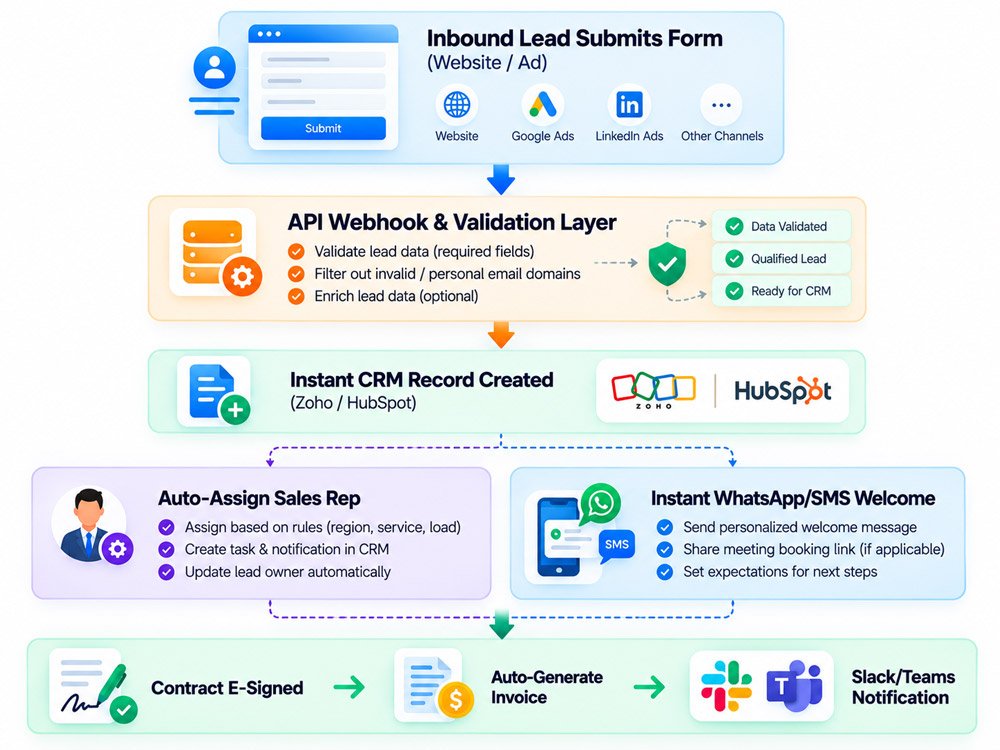
When a prospect completes a form, custom webhooks instantly validate the submission, create a deal in your CRM (HubSpot, Zoho, Salesforce), and assign it to the appropriate sales rep based on territory, deal size, or availability—delivering response times under 5 minutes.
2. Automated Client Onboarding
Once a deal reaches "Closed-Won," the automation pipeline triggers contract generation (DocuSign/PandaDoc), provisions customer portal accounts, sets up billing in QuickBooks or Stripe, and notifies the account management team via Slack or Microsoft Teams.
3. Bidirectional Inventory and Billing Synchronization
Prevent discrepancies between sales proposals and operational fulfillment by linking your e-commerce or custom software endpoints directly to ERP inventories and accounting ledgers.
4. Dynamic Customer Re-Engagement Triggers
Automatically detect when an active customer drops below standard platform usage thresholds or has an upcoming contract renewal, triggering tailored email or WhatsApp sequences for account managers.
5. Automated Cross-Department Reporting
Consolidate marketing acquisition numbers, sales pipeline stages, and accounts receivable data into centralized real-time executive dashboards.
No-Code Tools (Zapier/Make) vs. Custom API Webhook Pipelines
| Feature | Zapier / Make (No-Code) | Custom API & Webhook Pipelines |
| Setup Speed | Very fast (hours) | Moderate (1–2 weeks) |
| Recurring Cost | Expensive at scale (charges per task run) | Minimal infrastructure costs; no per-task fees |
| Complex Logic | Limited branching and multi-stage transformations | Supports complex calculations, data normalization, and fallback retries |
| Data Privacy | Customer data passes through third-party servers | Direct server-to-server encryption within your own cloud boundary |
| Error Handling | Basic notifications; tasks fail silently on edge cases | Automated dead-letter queues, detailed error logs, and auto-retry scripts |
Calculating the Return on Investment (ROI)
The financial return of business process automation is measurable:
$$\text{Monthly Savings} = (\text{Hours Saved per Week} \times 4.33 \times \text{Average Hourly Employee Cost}) + \text{Revenue Recovered from Faster Lead Response}$$
For a team of 5 sales and operations staff saving 4 hours each per week at an average rate of $30/hour, automated workflows return over $2,500/month in reclaimed productivity, independent of added revenue from improved conversion rates.
Streamline Your Operational Pipelines
Manual data entry slows response times and limits business growth. Custom automations ensure your operations run efficiently around the clock.
Contact WebK3 Technologies to schedule a workflow discovery session and map out your business automation architecture.