

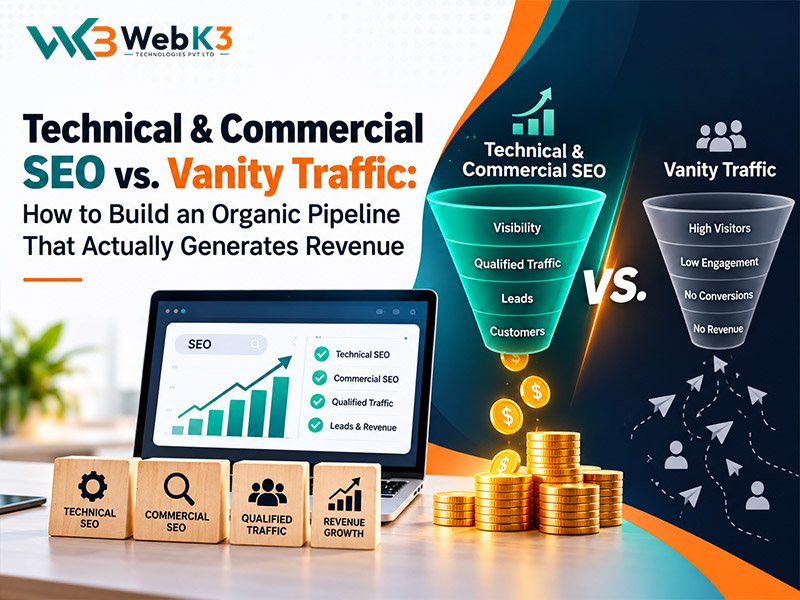
Many B2B companies have had negative experiences with standard search engine optimization agencies. Reports arrive showing upward-sloping organic traffic charts, yet the business sees no measurable increase in qualified sales inquiries.
This occurs because conventional SEO often targets vanity search volume—broad, top-of-funnel informational queries (such as "what is digital marketing" or "history of cloud computing") that attract students, entry-level researchers, and competitors.
Sustainable organic growth requires shifting from pure traffic volume to commercial intent, technical crawlability, and Answer Engine Optimization (AEO).
The Difference Between Vanity Traffic and Commercial Intent
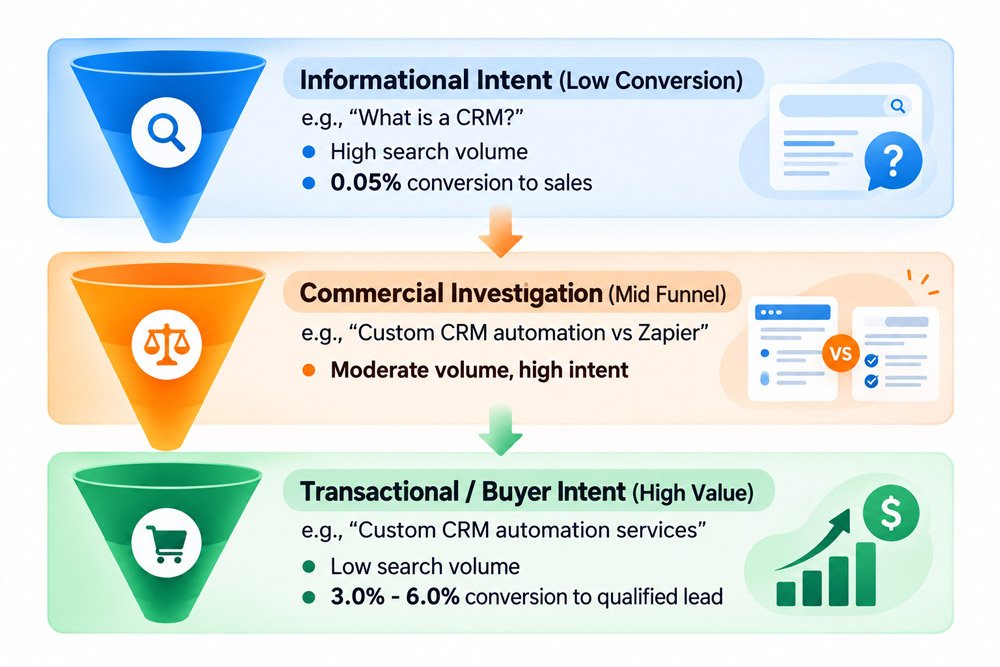
For service firms and B2B providers, a page generating 150 targeted commercial visits per month will reliably yield more revenue than a broad blog post generating 20,000 unqualified visits.
The 3 Pillars of Revenue-Driven B2B SEO
1. Technical Health and Crawl Efficiency
Search engines cannot index or prioritize pages they cannot crawl reliably. Technical SEO forms the foundation:
- Server Response and TTFB: Maintaining response times under 300ms.
- Core Web Vitals: Keeping Largest Contentful Paint (LCP) under 2.5 seconds on mobile.
- Clean Architecture: Eliminating redirect chains, duplicate canonical tags, and orphan pages.
- Structured Data: Implementing comprehensive Schema.org JSON-LD (
Organization,Service,LocalBusiness,FAQPage) to help search engines accurately classify your business entities.
2. Bottom-of-Funnel (BOFU) Content Architecture
Content should focus on topics prospects research immediately prior to making an inquiry:
- Alternative and comparison pages (e.g., Custom Development vs. Agency Retainers).
- Cost, pricing, and timeline breakdowns for specific technical implementations.
- Industry-specific use cases demonstrating measurable client outcomes.
3. Answer Engine (AEO) and Generative Engine Optimization (GEO)
Modern B2B buyers increasingly use AI-assisted search tools (Google AI Overviews, Perplexity, ChatGPT Search) to evaluate service providers.
To ensure AI systems reference your business:
- Structure content with clear definition statements within the first 50 words of major sections.
- Use structured HTML tables to present technical comparisons, timelines, and feature breakdowns.
- Maintain consistent brand citations and service descriptions across authoritative external directories.
Warning Signs When Evaluating SEO Agencies
- Guarantees of #1 Rankings: Search algorithms update continuously; reputable agencies focus on measurable KPIs (qualified leads, commercial impressions, pipeline revenue) rather than arbitrary keyword guarantees.
- Lack of Technical Scrutiny: An agency that focuses exclusively on blog copy while ignoring technical crawl errors and site architecture rarely delivers sustainable results.
- Reporting Traffic Without Conversions: If monthly reports do not track form submissions, phone inquiries, and qualified leads in GA4, the campaign is not aligned with business revenue.
Build an Organic Growth Engine for Your Business
Organic search should function as a predictable channel for qualified B2B inquiries, not an exercise in vanity metrics.
Connect with WebK3 Technologies to schedule a comprehensive technical SEO and revenue-conversion review.